(13 oz/yd²)
Silane

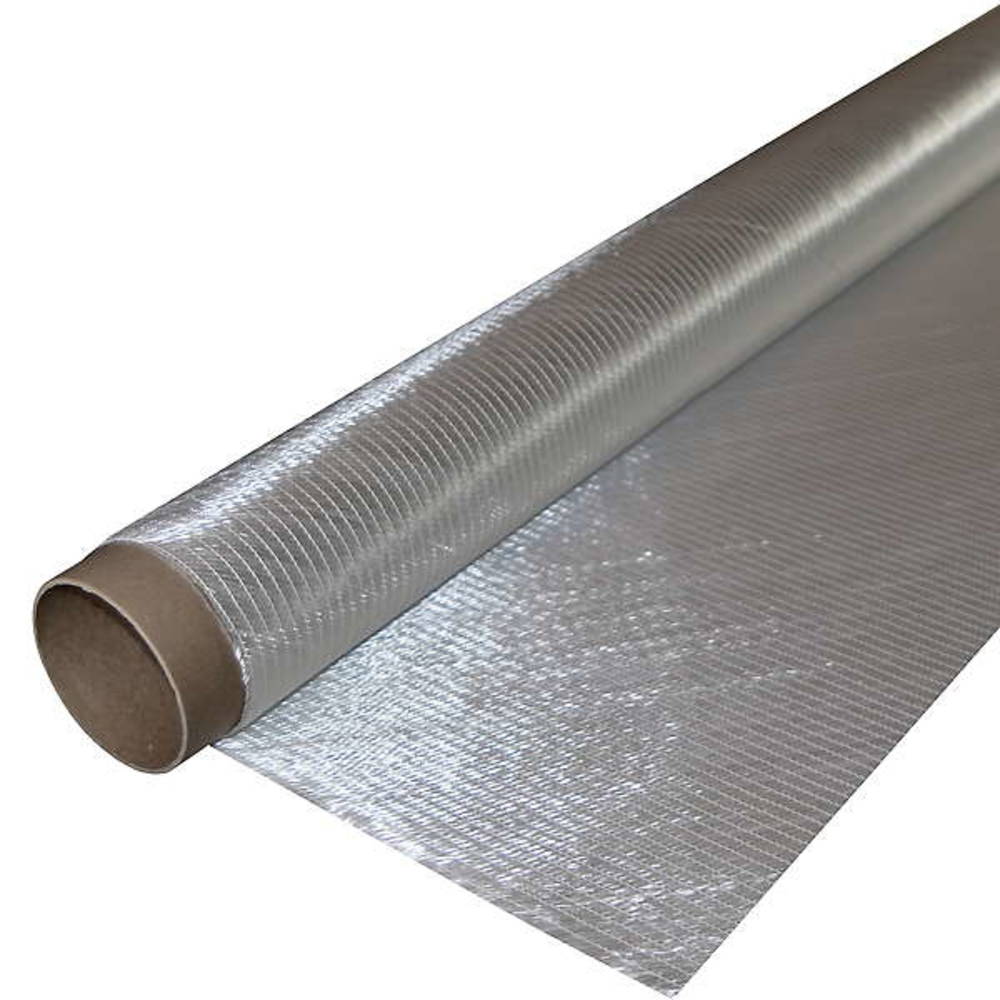
Glass non-crimp fabric 440 g/m² (biaxial, ± 45°), width 127 cm
USA: width 50", weight 13 oz/yd²
The 440 g/m² glass non-crimp fabric concentrates 434 g/m² of its primary glass reinforcement directly in the −45° and +45° directions. The fibre layers are stitched rather than woven, allowing them to remain largely straight. The higher areal weight provides efficient laminate build-up, while the generous 127 cm width enables large continuous cut pieces with fewer overlaps.
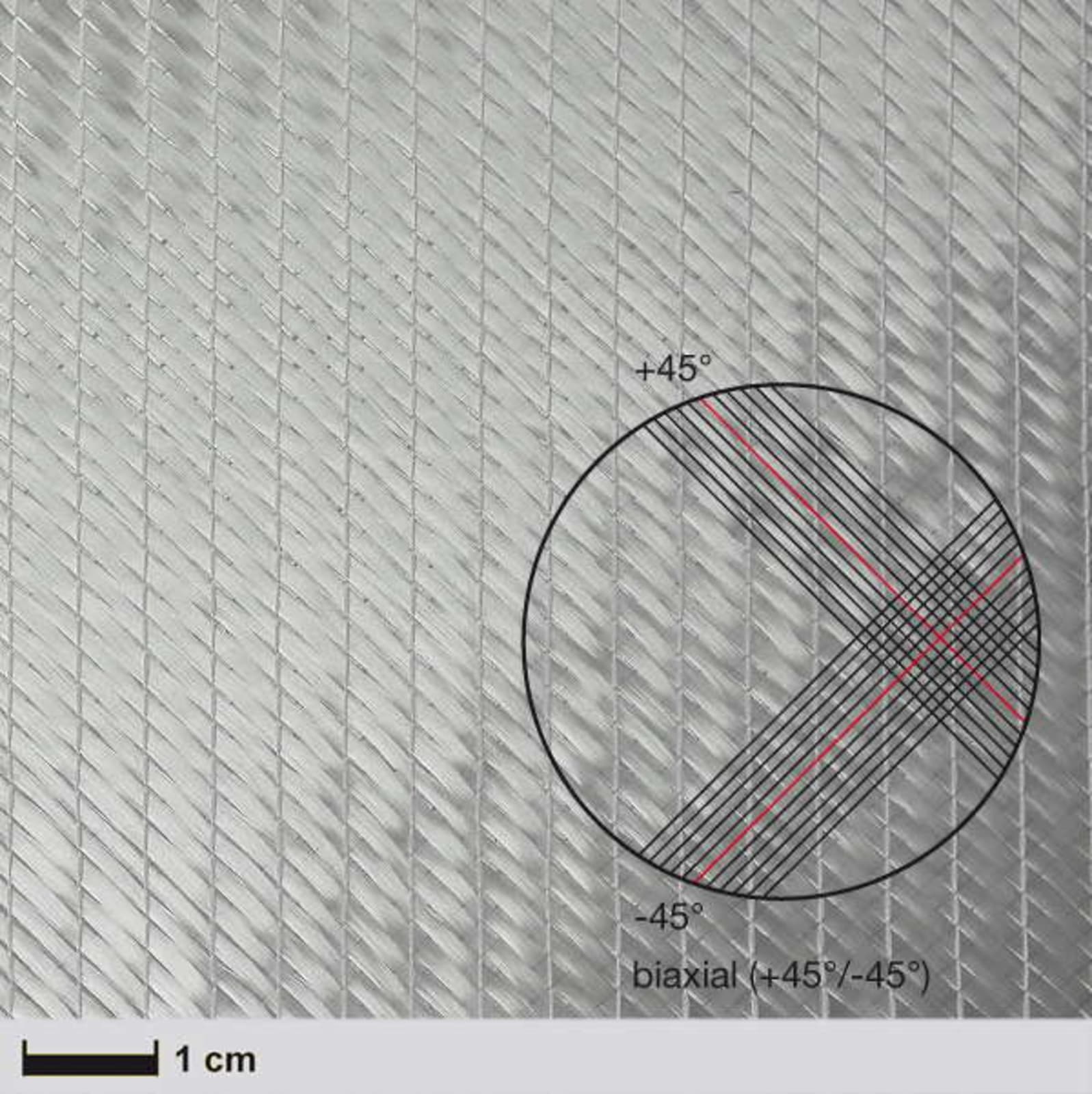
This multiaxial E-glass non-crimp fabric is specifically designed around a pronounced ±45° reinforcement architecture. The two primary layers contain 217 g/m² each and therefore provide almost the entire structural reinforcement. Very lightweight 0° and 90° layers stabilise the construction during cutting, positioning and laminating.
Unlike a conventional woven fabric, the individual fibre layers are not interlaced but held together with polyester stitching. The primary ±45° layers therefore do not contain the yarn intersections characteristic of woven fabrics. This allows the fibres to remain largely straight in their intended load directions and to be integrated efficiently into a load-oriented laminate design.
With an areal weight of 440 g/m², the reinforcement is particularly attractive for components requiring both defined ±45° fibre orientation and efficient laminate build-up. More reinforcing fibre is introduced with each ply than with lighter non-crimp fabrics, allowing greater laminate thickness to be achieved with fewer individual layers.
| Fibre type | E-glass |
| Construction | multiaxial stitched glass non-crimp fabric |
| Nominal designation | 440 g/m² biaxial ±45° |
| Total areal weight | 440 g/m² ± 5% |
| 1st layer −45° | 217 g/m², 300 tex |
| 2nd layer 0° | 3 g/m², 68 tex |
| 3rd layer 90° | 4 g/m², 68 tex |
| 4th layer +45° | 217 g/m², 300 tex |
| Stitching thread | Polyester, ≤ 10 g/m² |
| Layer bonding | stitched |
| Sizing | multicompatible / silane |
| Width | 127 cm ± 1.9% |
Benefits of the Non-Crimp Fabric
- 434 g/m² of glass reinforcement directly in the primary ±45° directions
- efficient laminate build-up due to the 440 g/m² areal weight
- largely straight fibre alignment without conventional woven yarn intersections
- ideal for laminate structures subjected to shear and torsional loading
- lightweight 0° and 90° support layers provide stable handling
- good conformity to radii and three-dimensional component geometries
- 127 cm width for large cut pieces and fewer overlaps
Applications
The biaxial ±45° non-crimp fabric is particularly suitable for components where shear forces, torsional loads or diagonal load paths represent an important part of the structural loading. The two substantial ±45° layers position the reinforcing fibres directly in these principal directions.
Its higher areal weight also allows a comparatively large amount of reinforcement to be introduced with each ply. This is especially advantageous for larger components and laminate structures where efficient build-up with a manageable number of plies is required.
Typical applications:
- boat and yacht construction
- automotive and motorsport components
- ultralight aircraft construction
- rotor blades and wing structures
- pipes and profiles
- torsion elements
- sports equipment
- sandwich constructions
- technical GFRP and hybrid laminates
Suitable Resin Systems
The multicompatible silane sizing allows processing with suitable epoxy, polyester and vinyl ester laminating resins, providing flexibility for a wide range of component, processing and performance requirements.
For a high-quality laminate, the resin should wet all fibre layers uniformly and completely. Careful consolidation supports a homogeneous laminate structure and helps minimise trapped air between reinforcement plies.
Calculated Data for Hand Lay-Up Laminates with 35 Vol.-% Fibre Content
| Resin consumption | approx. 361 g/m² |
| Laminate thickness | approx. 0.480 mm |
| Laminate weight | approx. 801 g/m² |
Benefits of the 127 cm Width
The 127 cm width is particularly attractive for larger composite components. Shells, panels, sandwich structures and other large surfaces can be covered with substantial continuous cut pieces. Fewer joints and overlap zones simplify processing and support more uniform fibre placement.
Technical Notes
Why biaxial ±45°?
The construction contains fibre layers at −45°, 0°, 90° and +45°. However, the two primary ±45° layers contain 217 g/m² each, giving a total of 434 g/m² in these directions. The very lightweight 0° and 90° layers stabilise the stitched construction. The designation “biaxial ±45°” therefore accurately describes the principal reinforcement directions.
Straight fibre orientation
Because the fibre layers are stitched rather than woven together, there are no conventional woven yarn intersections between the primary reinforcement layers. The glass fibres can therefore remain largely straight in their defined orientations and be used efficiently in a load-oriented laminate design.
Efficient laminate build-up
The 440 g/m² areal weight allows the required reinforcement thickness to be built up efficiently. At a calculated fibre volume fraction of 35%, one ply already produces approximately 0.48 mm laminate thickness.
Combination with other fibre orientations
For a load-oriented laminate design, the ±45° non-crimp fabric can be combined effectively with 0°, 90° or unidirectional reinforcement layers. This allows the fibre architecture to be tailored specifically to the loads acting on the component.
Processing
The non-crimp fabric is suitable for hand lay-up and appropriate vacuum-assisted processing methods. Its stitched construction helps maintain the defined fibre orientation during cutting, positioning and laminating.





Glass NCF 440 g/m² (biaxial ± 45°) 127 cm, roll/ 2 m
(surface area = 2.54 m²)
Item no. 1901582 Only 3 left in stock, more on the way (delivery time 1-2 days)
Add to Shopping ListScaled Price
- From Qty 2: 10,00%
- From Qty 5: 15,00%
Glass NCF 440 g/m² (biaxial ± 45°) 127 cm, roll/ 5 m
(surface area = 6.35 m²)
Item no. 1901584 Only 3 left in stock, more on the way (delivery time 1-2 days)
Add to Shopping ListScaled Price
- From Qty 2: 10,00%
- From Qty 5: 15,00%
Glass NCF 440 g/m² (biaxial ± 45°) 127 cm, roll/ 10 m
(surface area = 12.70 m²)
Item no. 1901585 Only 2 left in stock, more on the way (delivery time 1-2 days)
Add to Shopping ListScaled Price
- From Qty 2: 10,00%
- From Qty 5: 15,00%
Glass NCF 440 g/m² (biaxial ± 45°) 127 cm, roll/ 20 m
(surface area = 25.40 m²)
Item no. 1901586 Only 2 left in stock, more on the way (delivery time 1-2 days)
Add to Shopping ListScaled Price
- From Qty 2: 5,00%
- From Qty 3: 10,00%
Glass NCF 440 g/m² (biaxial ± 45°) 127 cm, roll/ 89 m
Scaled Price
- From Qty 2: 5,00%
- From Qty 5: 10,00%
- From Qty 10: 15,00%
all Prices price incl. VAT, possibly plus shipping
Article information
language: [language]
info3: [info3]
filetype: [filetype]
url: [url]
Instructions for use
language: [language]
info3: [info3]
filetype: [filetype]
url: [url]
MSDS
 MSDS Glass fabric, tapes, braided sleeves, rovings, yarns, chopped strands (PDF)
language: [language]
info3: [info3]
filetype: [filetype]
url: [url]
Product information
language: [language]
info3: [info3]
filetype: [filetype]
url: [url]
langue : [language]
info3 : [info3]
type de fichier : [filetype]
URL : [url]
Hazards identification - Glass non-crimp fabric 440 g/m² (biaxial, ± 45°), width 127 cm
Classification of the substance or mixture
The product is not classified according to the CLP regulation.Labelling according to Regulation (EC) No 1272/2008: Void
Hazard pictograms: Void
Hazard statements: Void
Signal word: n/a